

Categorize using the Diátaxis framework
The Diátaxis framework is a helpful guide for categorizing content based on your audience’s needs. Documentation can generally be mapped into one of these types:- Tutorials: Learning-oriented content for new users
- How-to guides: Task-oriented guidance for specific problems
- Explanations: Understanding-oriented conceptual discussions
- Reference: Information-oriented technical descriptions
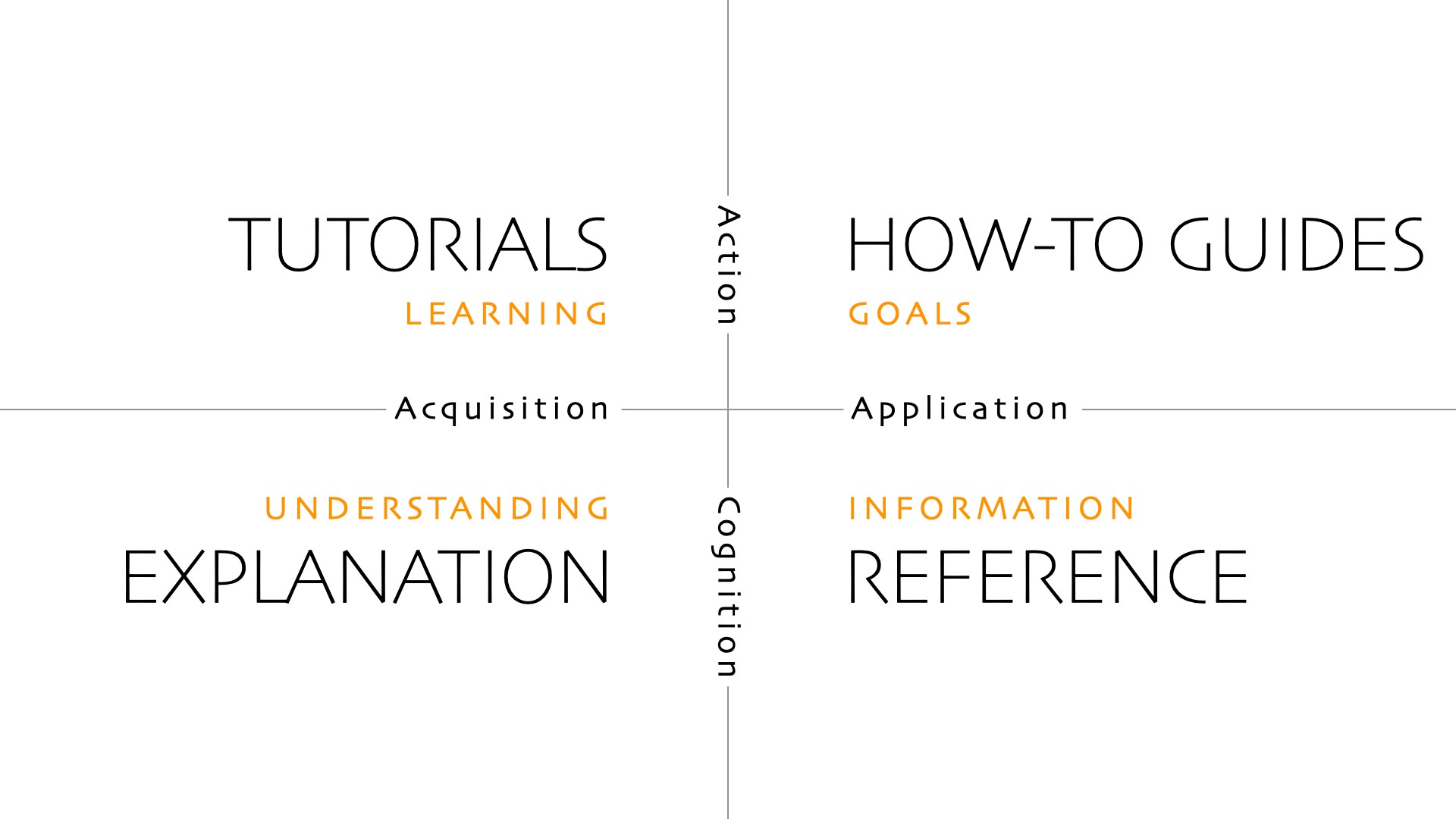
Picking a type
| Question | Tutorial | How-To | Reference | Explanation |
|---|---|---|---|---|
| What is the user’s goal? | Learn through practice | Solve a specific problem | Find precise information | Understand concepts |
| What is the user’s knowledge? | Beginner | Intermediate | Experienced | Any level |
| What is the primary focus? | Learning by doing | Achieving a goal | Providing information | Deepening understanding |
| How is the content structured? | Step-by-step | Problem-solution | Organized facts | Conceptual discussions |
| Is it task-oriented? | Yes, guided tasks | Yes, specific tasks | No, informational | No, conceptual |
| Is it designed for linear progression? | Yes | No | No | No |
Writing for each type
Tutorials (Learning-oriented)
- Audience goal: Learn something new through step-by-step instructions.
- Characteristics: Sequential and assumes no prior knowledge.
- Writing approach:
- Set expectations of what the user will achieve after reading.
- Use clear, incremental steps. Minimize choices that need to be made by the user.
- Point out milestones along the way.
- Minimize theory and focus on concrete actions.
How-To Guides (Problem-oriented)
- Audience goal: Perform a specific task correctly.
- Characteristics: Goal-driven and assumes some prior knowledge.
- Writing approach:
- Write from the perspective of the user, not the product.
- Describe a logical sequence and omit unnecessary details.
- Minimize context beyond what is necessary.
Reference (Information-oriented)
- Audience goal: Find details about a product’s functionality.
- Characteristics: Unambiguous, product-focused, scannable.
- Writing approach:
- Be scannable and concise.
- Prioritize consistency.
- Avoid explanatory content. Focus on examples that are easy to copy and modify.
Explanation (Understanding-oriented)
- Audience goal: Expand general understanding of a concept or highly complex feature.
- Characteristics: Theoretical, potentially opinionated, broad in scope.
- Writing approach:
- Provide background context, such as design decisions or technical constraints.
- Acknowledge opinions and alternatives.
- Draw connections to other areas in the product or industry.
Tips for success
- Maintain purpose: Before writing, assign each page a specific content type and stay focused on that purpose throughout.
- Optimize for freshness: Write evergreen documentation that remains accurate over time. Content tied to specific dates or frequently changing features belongs in changelogs or blog posts.
- Think like your users: Consider different user personas when organizing content. See Understand your audience for more information.
- Use templates: Start with content templates that provide the basic structure for each content type.
Related pages
Content templates
Copy and modify templates for each content type.
Style and tone
Write effective documentation with consistent style.
Understand your audience
Research and define your documentation audience.
Navigation
Organize your documentation structure effectively.
Improve your docs
Use data and metrics to improve documentation.